A Teacher’s Mission

“We have different gifts, according to the grace given to each of us. If your gift is…teaching, then teach” (Romans 12:6-7)

The Lutheran Church of Cameroon in West Africa has 31 congregations served by only 8 pastors. No new pastors have graduated since 1999. In 2014, Missionary Dan Kroll arrived in the town of Kumba as the lone WELS missionary in the country. In the Fall of 2016, Missionary Kroll and one other Cameroonian Pastor began training a new class of 11 pre-seminary students. Their work is challenging for sure, but is greatly enhanced by WELS volunteers who come to Cameroon for short-term teaching trips. Could you be a future volunteer teacher? Read Missionary Kroll’s post and find out more.

A single missionary family posted in an outlying town with no major industry or tourism is a challenging circumstance.  That was Missionary Dan Kroll and his wife Karen until October 2017, when Missionary Jeff and Stephanie Heitsch moved to the town of Bamenda, Cameroon (about four hours’ drive from Kumba). Add to that the challenges of curriculum development and guidance of a sister synod, and one realizes quickly that even two teachers at Kumba are not enough to do the work.

Enter EAGER VOLUNTEERS!!  “…each according to his own ability.” (Matthew 25:15)

Teacher Werner Lemke

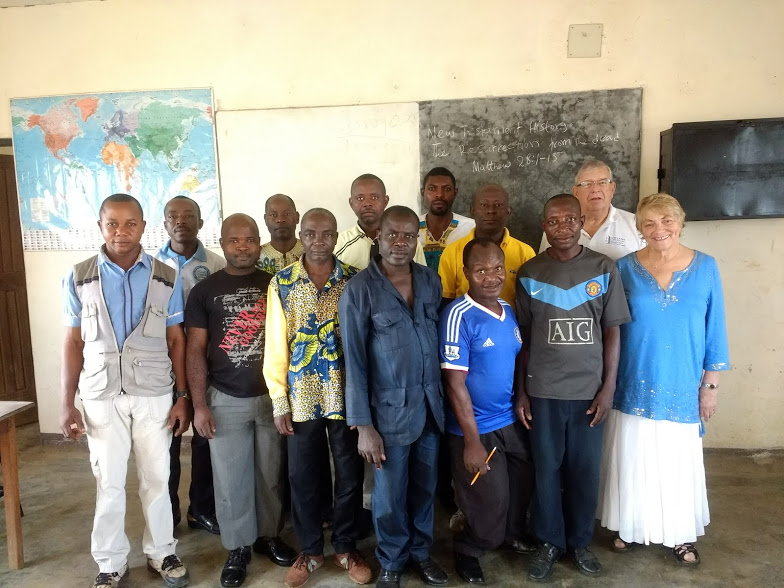
Our first volunteer teacher was Mr. Werner Lemke, a retired WELS teacher with African mission experience. Lemke taught at the Lutheran Bible Institute in Malawi from 1998-2006.  As we were starting our Bible Institute here in Cameroon, we asked Mr. Lemke to kick off our science program.  Since his wife Judy could not accompany him, Werner was only able to stay for three weeks.  The textbooks arrived late, so he had little opportunity to outline a full science curriculum for us. Perhaps we were a bit ambitious there! However, he introduced the Earth Sciences and helped our students understand that we study science to know the design of God’s creation.  It was a blessing to have him here.

Our first experience with a guest teacher was so successful that we decided to pursue others.

After much prayer, the Spirit brought Mr. Harry Mears and his wife Johanna into our focus in the Spring of 2017. (read more at https://welsfriendsofafrica.com/cameroon-connection/) As retired LES teachers, the two of them could teach Biology and World History as well as English Grammar and Music, respectively. When Harry experienced a heart attack in June 2017, he used the trip to Cameroon as a reason to work hard in therapy – and it worked!

Harry and Joanna Mears with their students

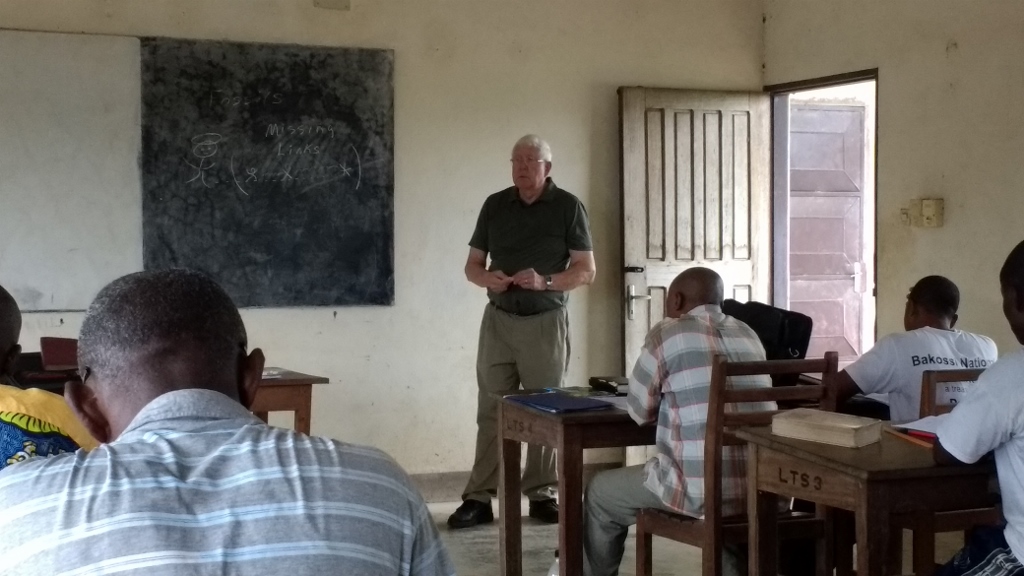
“Papa” Harry and “Mama” Johanna arrived on the 23rd of October and they formed great relationships in their teaching.  That also left missionary Kroll free to make a trip to Nigeria and to provide continuing education for pastors throughout the Lutheran Church of Cameroon.   An extra benefit of the Mears’ presence was the opportunity for our Cameroonian men to see another example of Christian marriage at work, a great blessing indeed. Watch a video of the students sending off the Mears:

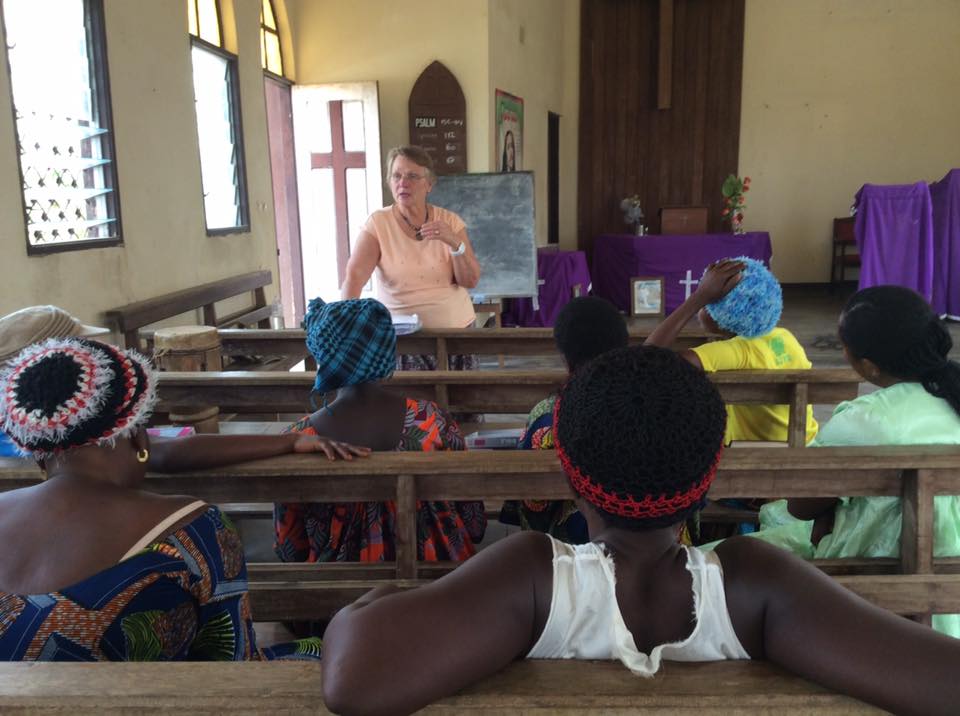
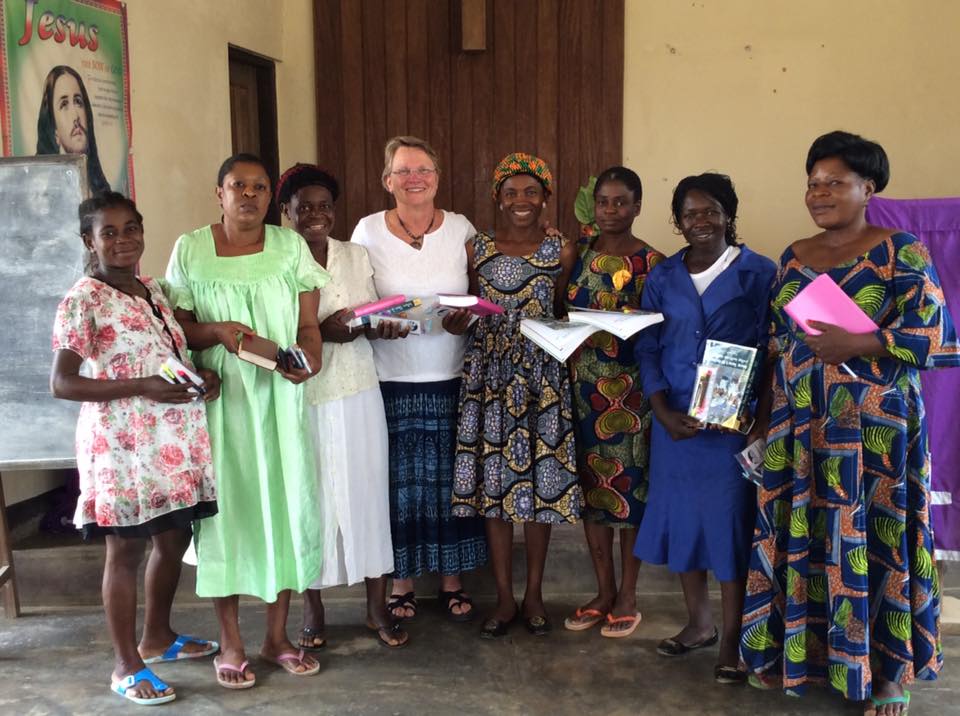
Three weeks after the Mears’ departure, our biology follow-up arrived. Nurse Kathie Wendland came to teach Health class. Being experienced in a variety of cultural settings, Kathie has been able to help our people (including some “frank talk” with the wives for one of the weeks) understand the health challenges they face and the false treatments that are sometimes proposed.  She was a blessing to push our work forward.

Kathie Wendland teaching health class

All of these volunteers have had a profound impact on our mission field in Cameroon. They have modeled authentic Christian life for our students. They have brought their expertise to the classroom in areas of study that we pastors do not have. They have helped people in the United States understand what their mission dollars are doing for peoples’ needs now, and how they are helping them for eternity

We give thanks to our Administrative Committee as well as the Board for World Missions for making it possible for those volunteers to come to Cameroon. They are our partners in our gospel work here for the glory of God!  We invite you to also partner with us in this exciting ministry, as you support us with your prayers and your offerings. And if you have the gift of teaching, may you use your gift for God’s glory no matter where you are.

Missionary Dan Kroll lives with his wife Karen in Cameroon

Please pray for those working in fields that are ripe for harvest. Share their story, engage with future news and receive updates. Go to this link to learn more about our mission fields in Africa and how the Holy Spirit is working faith in people’s hearts  https://wels.net/serving-others/missions/africa


God’s Business – As Ususal

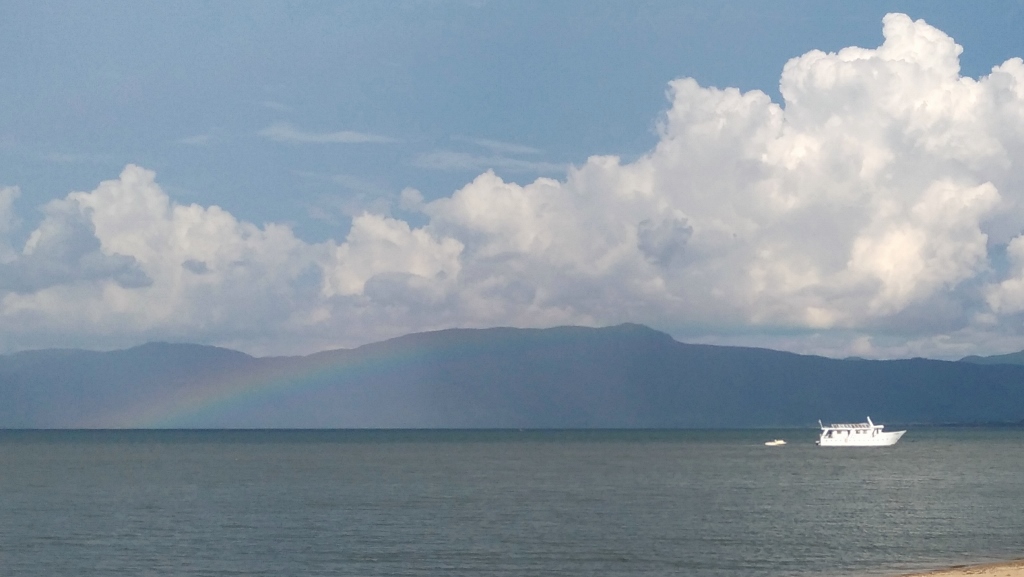
A rainbow reminder on the shore of Lake Malawi

I planted the seed, Apollos watered it, but God has been making it grow.” (1 Cor. 3:6)

To me, everything was business as usual.  Nothing stood out as extraordinary.  It was just another meeting.

Two weeks ago, the leaders of the Lutheran Church of Central Africa-Malawi Synod (LCCA-MS) met with the leaders of the WELS mission in Malawi.  Five Malawians represented the local synod.  Three missionaries represented WELS. We gathered at a rustic little lodge on the southern shores of Lake Malawi in a region called Mangochi. 

The scenery was stunning, but the meeting felt routine to me.  In the past 10 or 12 years, I have participated in dozens and dozens of such meetings.  So when we gathered in Mangochi, I didn’t think much of it.  It took the fresh perspective of a newly-arrived missionary to recognize what was extraordinary.

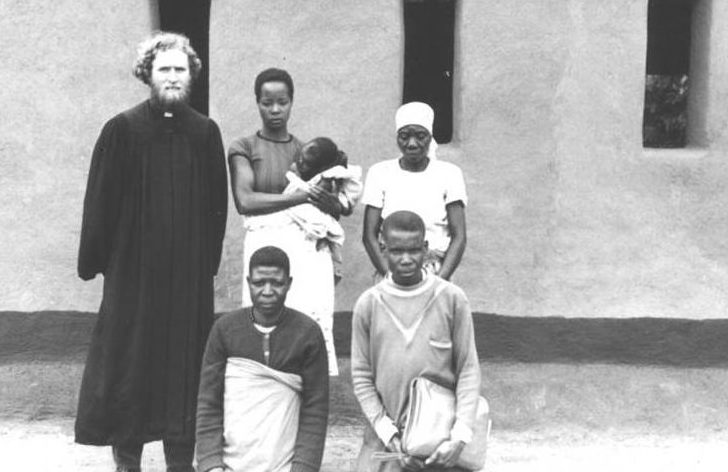
Missionary Steven Valleskey served in Malawi from 1971-78

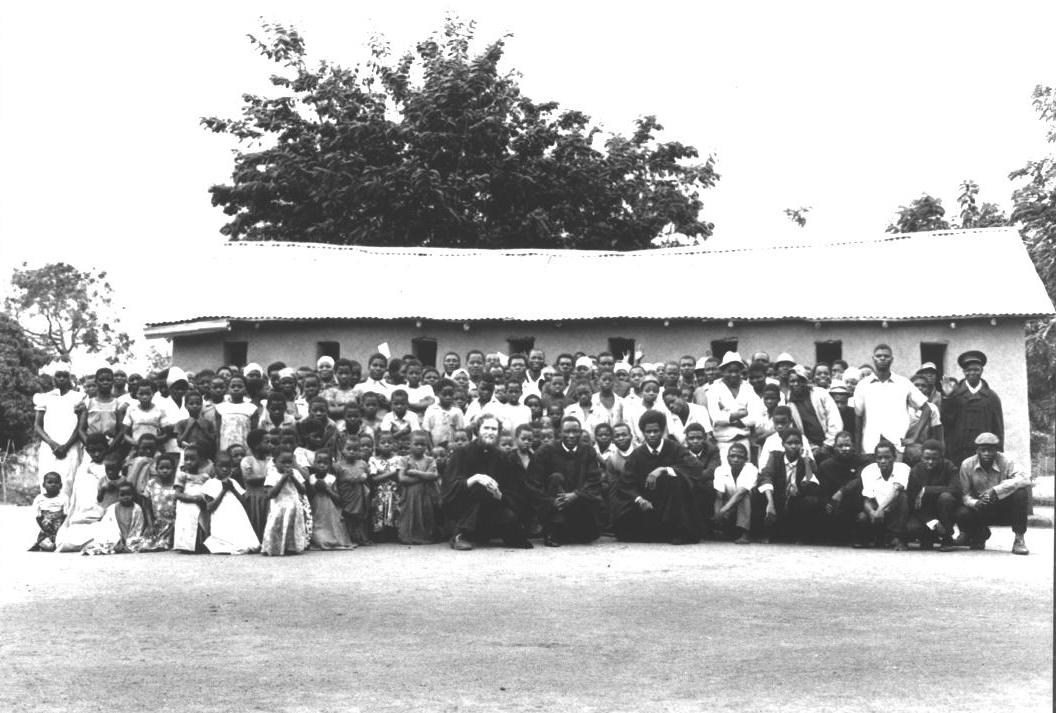
Sema was the first congregation in the LCCA-MS. Pictured in the front: Missionary Steven Valleskey, Pastor Deverson Ntambo and Evangelist Daison Mabedi

Let me explain.  The LCCA-MS is almost 55 years old.  In 1963, two WELS missionaries from the neighboring country of Zambia moved to the densely-populated southern region of Malawi.  Back then, WELS missionaries did 100% of the ministry in Malawi.  They preached all the sermons in the local languages, baptized all the babies and taught the confirmation classes.  Yes, there were a few dedicated laymen and church elders who could help with this, but the LCCA-MS did not have even a single Malawian pastor until 1976.

In fact, the missionaries weren’t just doing the preaching and baptizing.  Back in the early days, missionaries also served as the elected officers of the local synod.  A missionary served as synod president, another as vice president, as secretary, treasurer and so on.  The missionaries ran the meetings of the church.  The missionaries made the plans and controlled all of the funding.

Think about that for a minute.  Back in 1975, all the members of the Lutheran Church of Central Africa-Malawi Synod were native Africans, and all of the pastors and leaders of their synod were foreign missionaries.

How strange!  How very, very strange.

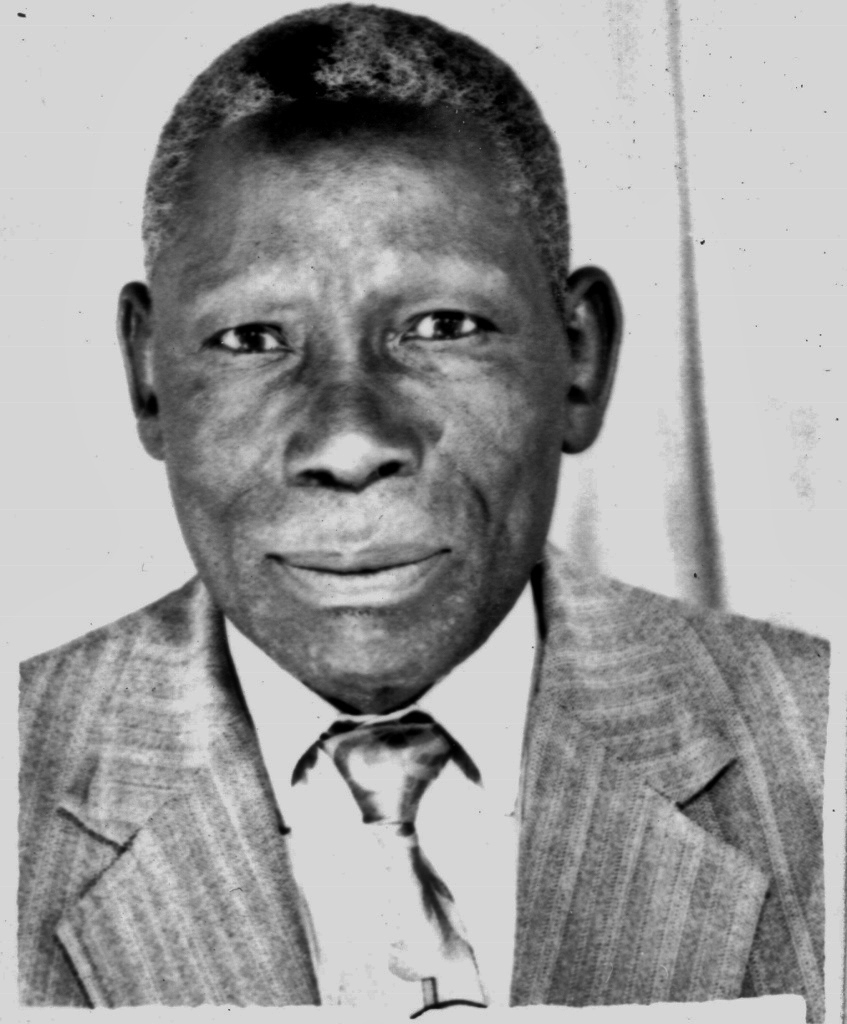
Pastor Deverson Mtambo, the first pastor of the Lutheran Church – Malawi Synod

Things are much different today.  Today there are about 35 Malawian pastors and vicars who serve the LCCA-MS. No congregation of the LCCA-MS is regularly served by an American.  Malawian pastors do virtually all of the preaching, all of the baptizing, all of the confirmations and the funerals.  All of these pastors are paid and supported by the congregations that they serve.  Today, the executive committee of the LCCA-MS is a five man board, and every one of them is a Malawian.  They stand at the head of a Synod that numbers more than 45,000 baptized souls.

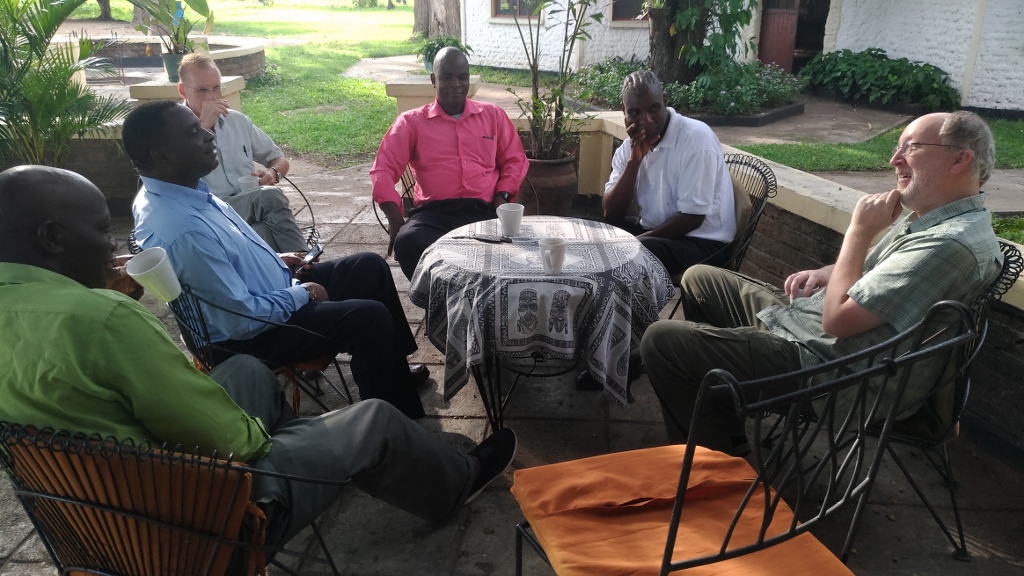
L-R: Rev. Patrick Magombo, Rev. Riphat Matope, Missionary John Holtz, Rev. Alfred Kumchulesi, Rev. B. Liwonde, Missionary Mark Panning

Two weeks ago I sat beneath a large Kachere tree on the shores of Lake Malawi.  As a warm breeze blew across the lake and monkeys bounded through the branches of the tree, three WELS missionaries met with the leaders of the local Malawian synod.  All five of those LCCA leaders had names that might sound strange to you – names like Rev. Riphat Matope (mah-TOE-pay), the Synod Chairman, or Rev. Alfred Kumchulesi (KOOH-mtchoo-lay-see), the Synod secretary – but they are not strange to me.  They are my friends, my brothers in God’s family, my fellow workers in Christ’s vineyard.  So we sat and talked like brothers, easily and openly, about the gospel ministry we share.   

There was a time not too long ago when the LCCA-MS had very few members and not even a single pastor.  Now they have 45,000 baptized members and better than three dozen pastors.  There was a time when foreign missionaries completely controlled the operation and administration of the synod.  But now we take the fact for granted: It is a Malawian synod, and Malawians will lead it.

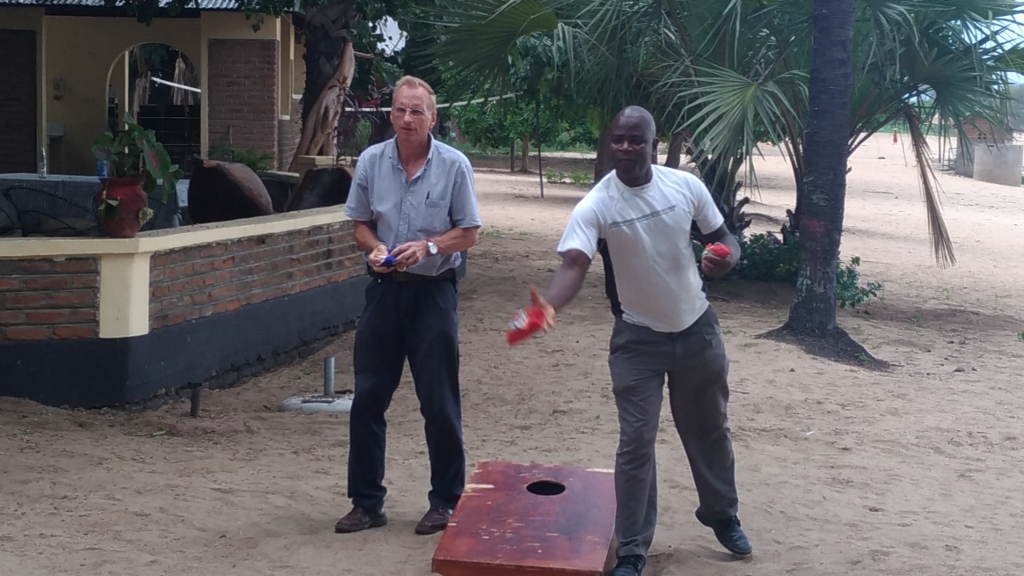
Winding down after a long day with a game of Cornhole

And perhaps the most amazing thing is this… No one bats an eyelash anymore.  It’s business as usual.  It’s our standard practice over here.

Amazing growth. Amazing grace. God’s business – as usual.

Missionary Mark Panning teaches at the Lutheran Bible Institute in Lilongwe, Malawi

Please pray for those working in fields that are ripe for harvest. Share their story, engage with future news and receive updates. Go to this link to learn more about our mission fields in Africa and how the Holy Spirit is working faith in people’s hearts  https://wels.net/serving-others/missions/africa


The Lord’s Time for Mozambique

“Paul and his companions traveled throughout the region of Phrygia and Galatia, having been kept by the Holy Spirit from preaching the word in the province of Asia.” (Acts 16:6) For 50 years the Spirit has kept WELS from entering Mozambique. We believe and pray that God is now calling us to this ripe mission field. Listen to our story…

The First Look at Mozambique

In 1962 Central Africa was still under the colonial administration of the British government. WELS missionaries had established a presence in the country of what was then called Northern Rhodesia (Zambia). There had been a major shakeup of the mission staff, but a solid foundation was set in place and growth was steady. Missionaries Robert Sawall and William Scheppe were serving at the Mwembezhi Mission, while Theodore ‘Tate’ Sauer, E.H. Wendland, Richard Mueller, and Raymond Cox were located in Lusaka.

L-R: W. Schweppe, R. Cox, E. H. Wendland, R Sawall, R. W. Mueller and T. Sauer

In that year, representatives of the Lutheran Church Missouri Synod (LCMS) visited WELS Missionaries living in Lusaka. The delegation was on its way to Portuguese East Africa (Mozambique) to explore the possibilities for mission work. After their visit they stopped again in Lusaka, convinced that Portuguese East Africa was “ripe for the harvest.” However, they told the WELS missionaries, “You are next door and are in a much better position to start work there rather than us.”

At the same time missionaries were exploring other areas to expand the work, notably the Copperbelt area of Zambia, as well as neighboring Nyasaland (Malawi). Missionaries Richard Mueller and Raymond Cox recommended that WELS enter Malawi with all haste. Plans to enter Mozambique were ‘temporarily’ put on hold. Mueller and Cox were called to Malawi in June 1963 and the Lord blessed that decision in ways no one could have foreseen. Today there are over 40,000 members of the Lutheran Church of Central Africa – Malawi Synod.

Second Chance

In 1968 there was a “bump” in the road to our work in Malawi. The Malawi missionaries were told by the Office of the President of Malawi, “Your church cannot expand into any new areas without the consent of the President.” To engender good relations with the government of Malawi, in 1971 WELS began operating the Lutheran Mobile Clinic in the Salima area where access to medical care was severely limited. Miss Edith Schneider (now Mrs. E. Hintz) was the first nurse.

An abandoned tank from Mozambique’s civil war

The Malawi missionaries, who were based Blantyre, made frequent visits to Salima to support the nurses and fellow Missionary T. Kretzmann. At that time the best route from Blantyre to Salima passed through the town of Dedza, which is located on the border of Malawi and Mozambique. Due to internal political conflicts in Mozambique in the early 1970s, refugees began pouring into Malawi. An estimated one million Mozambicans perished during a 15 year civil war. The missionaries witnessed grass huts being built by refugees on the Malawi side of the border. In just a few years, Malawi’s population increased from 7 million to 11 million. The Malawi mission staff asked the Mission Board to call another missionary who could work among the refugees, but unfortunately funding was not available at the time.

The Third Time’s Not a Charm

In 1990 a special WELS Mission offering called, “Lift High the Cross” funded the calling of Missionary Tim Soukup to serve the Mozambican refugees living in the border area by the towns of Dedza and Ntcheu, Malawi. Three years later however, Mozambique’s civil war came to an end. By mid-1995 more than 1.7 million refugees returned to their homes in Mozambique from neighboring countries, part of the largest repatriation witnessed in sub-Saharan Africa (source: https://en.wikipedia.org/wiki/Mozambique). This resettlement coincided with Missionary Soukup leaving Malawi in 1995, having only done a little work with cross-border Mozambicans together with sainted Rev. Dais Boloweza. Some national pastors continued to serve some cross-border congregations. Efforts were made to meet with a group near Tete, Mozambique but these visits were very limited because of the distance (Tete is about 200 miles inland from the Malawi border).

Missionaries Bill Meier and Paul Nitz met with local missionaries in Mozambique

The Fourth Attempt

In 2005 the WELS Administrative Committee for Africa requested another survey of the Mozambique field. Missionaries Bill Meier and Paul Nitz made a visit in February 2005 to the capital city of Maputo in the south of the country. Encouraging reports about the stability of the country and the need for humanitarian work led to a second visit eight months later to the north, where there was considerably less mission activity among the most densely populated part of the country, and less crime. In the city of Nampula they met an expat missionary named Dave Lepoidevan. He encouraged them that mission work in this part of the country had just recently begun. He and other local expats encouraged the WELS Mission to use higher education (like a teacher training college) as an effective form of mission work in Mozambique, especially if it offered English classes. They also informed the WELS missionaries that it was necessary to speak Portuguese in order to live and work in Mozambique.

L-R: Bill Meier, Ken Cherney, Alfredo Nahia (director of local teachers’ college), Steve Valleskey

Not long after that, Meier made a third trip to Mozambique together with Portuguese speaking Ken Cherney, former missionary to Brazil, and Rev. Steve and Sally Valleskey, former missionaries to Malawi. They concurred with the mission strategy of using higher education as an outreach tool. They also heard from local missionaries about the necessity for learning Portuguese, preferably before coming to Mozambique.

L-R: Jeff Enderle, Artur Villares, Bill Meier

The report and proposals out of that trip convinced the WELS Board for World Missions to call Bill Meier and Jeff Enderle as missionaries to Nampula, Mozambique in 2007. They were sent to learn Portuguese in Lisbon, Portugal, where Rev. Artur Villares serves the Lutheran Church of Portugal, a member of the Confessional Evangelical Lutheran Conference (CELC). Both missionaries made excellent progress learning Portuguese, and they also made a visit to Mozambique to look for housing. But the move to Nampula was delayed by various factors, including problems with visas and registering the mission with the government.

And then at the end of 2008 the world’s economy came to a standstill in the Global Recession. Investment losses were in the billions, including investments made by WELS. Funding cutbacks forced the Board for World Missions to recall Meier and Enderle to the United States and to defund the Mozambique mission in 2009.

One More Time

In 2009 there were over 4,000 Mozambican Lutherans living across the border from Malawi. These people speak Maravi, a language that is almost identical to what is spoken in Malawi and parts of Zambia. Over 600,000 Chichewa speakers live in Mozambique, representing about 4% of the country. Due to government restrictions, personal visits to these Lutherans have been very limited. Work is slowly progressing on registering the mission.

Missionary John Holtz baptizing children in Mozambique

But even though the Lord has made us wait so long to enter Mozambique, he has been working quietly through the Word which has been sown. During a recent visit 61 people were baptized at a worship service! It is evidence of Jesus’ words in John 3:8, “The wind blows wherever it pleases. You hear its sound, but you cannot tell where it comes from or where it is going. So it is with everyone born of the Spirit.” After over 50 years of waiting, we pray that the Spirit of God will finally allow WELS and the LCCA-M the privilege of serving our fellow Lutherans in Mozambique.

Missionary John Roebke serves as the Missionary of Publications for Malawi. He is also the Communications Manager for One Africa Team.

Special thanks to Raymond Cox and Bill Meier for their help with this article. Ray Cox is retired and lives in Oshkosh, WI. Bill Meier is the CEO of Kingdom Workers kingdomworkers.com

Please pray for those working in fields that are ripe for harvest. Share their story, engage with future news and receive updates. Go to this link to learn more about our mission fields in Africa and how the Holy Spirit is working faith in people’s hearts https://wels.net/serving-others/missions/africa