Learning to Love Malawi

Recently I’ve been digging through old photos,
looking over the 25 years I’ve lived in Malawi as a missionary
wife. There are an amazing amount of memories that come to mind looking over
those pictures. My husband, Paul, was assigned to Malawi when he graduated from
the Seminary in 1993. In remembering those early years, and comparing them to
our life here today, several things came to mind.


We didn’t know much about Malawi when we
arrived in 1993 with our one year old son. Paul was called to serve rural
congregations in the North of Malawi. We knew he was called to teach God’s
Word to the people there. We had something valuable to share and were willing
to do it.  What we didn’t
know at the time was that Malawi, and the millions of people who live here, had
something valuable to teach us. 
Reflecting back, I can clearly see how God provided for us in big and
small ways.

The early years – Malawi, Africa

Our second child was born in 1995 while living in the small town
of Mzuzu.  When the doctor who delivered
my baby asked if I had packed a flashlight I realized that I wasn’t
as prepared as I thought I was. Power cuts and dim lights are common. I learned
to be ready for scenarios I hadn’t had to think about living in the
U.S.

After our daughter was born we had planned to travel throughout
Malawi. I learned that some items, like disposable diapers, were impossible to
find in Mzuzu. I was resigned to traveling for 10 days with a toddler and a
newborn with only cloth diapers. It was then that I learned that God is much
better at planning ahead than I am. 
Weeks before I even knew I would need them, a group of Christian women
in the U.S. had a baby shower for me and shipped an enormous box of disposable
diapers to Malawi. The diapers arrived two days before our trip. God’s
timing was the best.

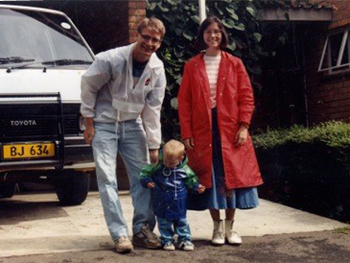
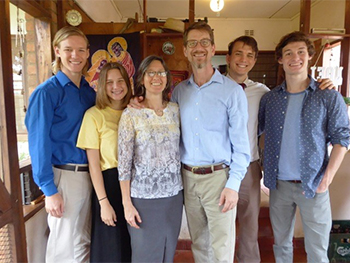
Nitz Family – Christmas 2018

As Paul and I met the people of Malawi, we saw that many
Malawians struggled with the effects of poverty. Shortages of food, water,
medical care and jobs impacted people’s daily lives. As the needs of
Malawians were made known to us and we sought ways to help,  Paul and I were learning a lesson about
giving and hospitality that Malawians had to teach us.

From our early days of language learning and visiting people in
their homes, to traveling to remote villages with Paul to greet people who had
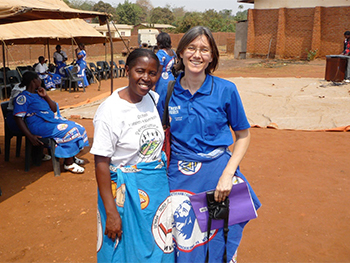
never seen a “European” woman and her  baby before, we were welcomed with clapping,
singing, smiles.  Chairs appeared out of
no where for us to sit on while our 
Malawian hosts sat on the ground. If possible, a bottle of CocaCola or
Fanta was procured for us. We never left empty handed. Mangoes, green maize,
sweet potatoes, a live chicken – these people were happy to share with us. Not
because we needed theses things, but because they wanted to show their love to
us. Malawian’s have a phrase, Tikulandirani ndi manja awiri! We
welcome you with both hands!
 
They welcomed us  not just with
their hands, but with their hearts as well.

Yes, I’ve learned a lot during my years in Malawi.  I’ve learned to drive on the left hand side of the road. I can navigate muddy, rutted roads that look impassable to the uninitiated. I’ve treated our neighbors’ dogs who had venom spat in their eyes from encountering a huge spitting cobra. I learned it’s not really a good idea to pick up a giant horned chameleon on the side of the road and try to to take it home in the car. These are all good things to know to live well in Malawi. But most of all, I’ve learned that God’s people love each other no matter where they are in the world.  God’s people in Malawi have shown their love to me and my family for 25 years, and by God’s grace we’ve been able to join with them in worship, Bible study, English classes, Sunday School, weddings, funerals, births and graduations.  While my own family is growing up and moving away, and I can’t physically be there for them in all the ways I wish I could, I am learning God provides for all our needs, big and small, in ways that I never even imagined He would.

Written by Susan Nitz, missionary wife in Malawi, Africa


If We Settle on the Far Side of the Sea

How was this winter in Minnesota, where I have been a pastor since 2015? Long. Is that why some of us are moving to Africa, and the others hope to visit? No. Above is our family by the Gulf of Mexico. It was January 1. We were in Sarasota, Florida, where we used to live. From left to right: Dan; Donovan, 14; Drew, 12; Danae, 22; Deb; Deanna 25; Daria, 18; and David, 21. Three of us — Dan, Deb and Drew — are getting ready to head across an even bigger body of water than the Gulf. I’ve been called as theological educator for the One Africa Team.


We will be based in Lusaka, Zambia, but my main work will not be at the seminary there. I am to teach and coordinate others’ teaching of African undergraduates and graduates. Where? WELS walks hand in hand with confessional Lutheran church bodies in Cameroon, Nigeria, Malawi, Ethiopia, Kenya and Zambia. Opportunities are emerging in Liberia, Mozambique, Rwanda and Uganda.

Can you picture our ascended Lord putting his right hand on John on Patmos, after John fell before him, as though dead? John was surrounded by the Aegean Sea on that island, as he fainted. He was far from home, exiled due to his testimony about Jesus. Jesus touched him and told him, “Do not be afraid. I am the First and the Last. I am the Living One; I was dead, and now look, I am alive for ever and ever! And I hold the keys of death and Hades” (Revelation 1:17–18).

Jesus’ nail-pierced right hand has been on my family and me for longer than I can remember. For instance, my mother’s father, Heinrich Vogel, used to teach at our seminary in Mequon, Wisconsin. Once he was asked to teach in Japan for a year. My grandmother did not want to go. Flying made her uneasy. Finally, she objected to my grandfather, “I want dirt beneath my feet.” He offered to bring along a bucket of dirt onto the plane, so she could keep her feet on dirt. She still refused.

That was that. He declined. Little did he know that some of his interest in teaching the gospel in a faraway place — even his interest in Hebrew — would get passed down to one of his grandsons. My wife’s mother, likewise, would tell you that when she was a young WELS teacher, she wondered about teaching in Africa. She was one of the first teachers at St. Philip’s Lutheran School in Milwaukee, Wisconsin.

I first got the chance to teach in Africa in 2012, when Pastor Joel Jaeger and I were asked to teach for three weeks at Christ the King Lutheran Seminary in Uruk Uso, Akwa Ibom, Nigeria. The next October Pastor Dan Voigt and I taught there again.

I remember when Solomon, our driver, first drove Joel and me to the mission house in Uruk Uso. Michael Egar, now a pastor in Cross River State, Nigeria, took one look at me and joked, with a big smile, “You must be Akpakpan’s son. You look just like Akpakpan!”

I admit, I share a similar face shape and eyes with Akpakpan, a veteran Nigerian pastor now in heaven. I am taller; his face was darker than mine. He was such a help to me, sitting in the back of the classroom, chiming in at just the right moment, here and there. I can still hear him saying to the students, “Yes. That is right. That is what God’s Word teaches.” Such experiences helped shape me. What a joy. What grace: Having a small part in training others for ministry in places so different from where I have been a pastor on this side of the ocean (Illinois, Florida and Minnesota).

Now our family looks back at ministry in cities, suburbs and a small town. We remember the ways we had to adjust when we all pitched in to start a new church in Florida, a spot with different weather and customs than where we had been, which after some years became home. We are surprised at how God has prepared us all in various ways — even when we left one son in Florida when the rest of us moved north in 2015, or how God led us to doctors at the Mayo Clinic in Rochester, Minnesota who have been so helpful to two of our children with difficult diseases.

Since 2014 I have served with others on the Psalmody Committee for our synod’s new hymnal. Have the psalms given you comfort and direction, in Christ? I hope they will do so more and more. David sings to God in Psalm 139,

“Where can I go from your Spirit?
Where can I flee from your presence?
If I go up to the heavens, you are there;
if I make my bed in the depths, you are there.
If I rise on the wings of the dawn,
if I settle on the far side of the sea,
even there your hand will guide me,
your right hand will hold me fast” (139:7–10).

Now our family sings that 3,000 year old song in a new light. As I write this, one of our
daughters is flying over the Arctic Ocean, on her way to a short-term mission trip in China. She will soon fly over the Pacific Ocean, too.

Join our family in song, won’t you?

Missionary Dan Witte will be moving to Lusaka, Zambia this summer


Ready for Either

Don’t laugh.  Ok, maybe you did already. Perhaps if you looked at the picture above before you started reading, you wondered what it was; and maybe you had a bit of a smirk or a smidgeon of a chuckle. That’s ok! : ) Maybe we didn’t get the lion’s share of drawing talent when the Lord handed out artsy kinds of gifts, but we tried. At our most recent Professional Development Course1, three pastors in the group teamed up with me to draw an image of an ancient Roman coin. The old coin pictures an ox standing in front of an altar and a plow. The altar symbolizes a sacrificial death; the plow symbolizes a lifetime of service.  Underneath the picture are the words

Ready for either.


We are studying the lives of the 12 disciples.  My, oh, my, how the Lord transformed these men of varying personalities, gifts, strengths, and weaknesses. God shaped them and molded them; He equipped them for a lifetime of service or sacrifice or both. Take an example of each: James and John. James was murdered by King Herod.  The evil King had him put to death by the sword (Acts 12:2). By the way, tradition says that most of the others were also martyrs, suffering horrible, painful, excruciating deaths.

Flayed.
Stoned.
Crucified.
Sawed in two.2

The ox on the altar.

On the other hand, John was banished to an island3 and served Christ with his long life.  But because of his faith in Jesus, “the one whom Jesus loved” still had his share of suffering. A long lifetime of service.

Alone.
Abandoned.
Deserted.
Cut off.

The ox pulling the plow.

Different paths for each, but each was called by the same
One:  Jesus Christ.  “Come
Follow Me, and I will make you fishers of men.”4 

He called. They followed. And Christ equipped each disciple for a life under the cross. Ready for either.

So, what kind of people does God call to service and sacrifice even today? That was the recurring question of the day.  Actually, that very question was before us for two full days at a place called Fisherman’s Rest.

Eight of us studied the lives of the 12 disciples.  As we did so, we also considered our own lives of sanctification.  We, too, have been called by Christ to follow him. We are called, not only to learn of Him, but learn from Him.  Called to serve Him with our gifts and abilities, our talents and strengths. 

You, too, my dear Mission Partners. Wait, what’s that I hear?  You’re saying, “But we are just common, ordinary people!?” I’m glad you mentioned that.  So were “the 12.” And so are we here in Malawi.  Pastors, Evangelists, Missionaries.  Wives and kids.

Common.
Ordinary.
Unexceptional.

The kind of people that our Lord loves to use.  Also take note of your family members and congregation.  Common folk with an array of personalities!

  • Some quiet, others loud.
  • Some gentle, others boisterous.
  • Some taking things slowly, others acting quickly.
  • Some good with the crowds, others preferring the individual. 
  • Some zealous and intense, others calm and reserved.
  • Some coming from a past that would make you blush, others have been on the sanctified, “narrow” road their whole lives. 

All fishers of men. All serving the Lord.

Blantyre Pastor’s Group

Under the cross.

But isn’t life under the cross over the top with pain and suffering? Rev. Daniel M. Deutchlander, in Grace Abounds, helps answer that good but sometimes frightening question:

“So it is just as Jesus said: ours must be lives lived under
the cross, not just lives that could be, should be, might be, or sometimes are
under the cross.  A life under the cross,
a life of self-denial for the sake of Jesus and His Word, is a life in which I
struggle against the inborn and deeply rooted inclination of my sinful flesh to
put self first; I seek to put the Word of God and the best interest of those I
am able to serve before my wants and self-interest, whether that’s convenient
or not, easy or not…5

Rarely is it convenient.  Rarely is it easy. Come to think of it, is it ever?

And yet it is the life to which Jesus has called us:  “Come follow me and I will make you fishers of men.”

Such kind of fishing is not easy
work.  The devil, like a roaring lion is
out to devour us; our own sinful flesh is constantly battling our new self in
Christ; the world confronts us with temptations all around.

All three combine to make our life
under the cross burdensome and tiresome. 
Guilt weighs heavy; shame even heavier. 
But Jesus has an answer for that too:

“Come to me, all you who are weary and burdened, and I will
give you rest.”6

So what do we get when we combine Matthew
4:19 and Matthew 11:28?

Fisherman’s Rest.

It’s not only where we were, it’s who we
are and what we’ve received.

Ah, the tremendous
gift and transforming power of forgiveness of sins!  Refreshes even the weariest of fishermen; strengthens
even the weakest of heart.

Studying at Fisherman’s Rest

The Blantyre Pastors group found such gift and power as we heed the call to the altar or to the plow.

Ready for either.

Sincerely,

John Holtz

Your Malawi
Mission Partner

  1. The current Professional Development Course is about Sanctification.  It is entitled, Come Follow Me…
    • You Common, Ordinary men,
    • With the strengths I’ve give you,
    • To an uncommon, extraordinary life.
  2. Also see Hebrews 11. 
  3. Revelation 1:9ff
  4. Matthew 4:19
  5. Grace Abounds, page 491.
  6. Matthew 11:28