What do you do in Malawi?

Mindy Holtz and Lamson Chimaliro

When I tell others that I live in Malawi one of the first
questions they ask me is, “What do you do there?  What is your job?  How do you spend your time?”

For many years my answer was, “I’m a housewife.”  Taking care of the kids, husband and home
took up most of my time (and still does, minus the kids).  In spite of our “exotic” location living in
Africa, the laundry, grocery shopping, cooking and cleaning has to be done here
as anywhere else in the world.  I get the
impression that some people imagine that my life is very interesting.  Perhaps it felt like that a little bit when
we first moved to Africa 22 years ago. 
But the novelty has long since worn off…


In 2014, I had a chance to add another role to my repertoire.  The mission offered me a job as Assistant to
the Financial Secretary!  I happily
accepted.  This gave me the opportunity
to help a missionary spend less time on paperwork and more time on gospel work.  In general, I like working behind the scenes (In
fact, I’m cringing right now even writing about what I do…).

The current Financial Secretary, Mark Panning, is a WELS
missionary who teaches at the Lutheran Bible Institute. He also has been given
the duty of overseeing the mission expenses of the Malawi field.  He is responsible to pay the bills, account
for the money, and budget for the future. 
As his assistant, I help him do all this.

Mark Panning teaching

Bill paying and record keeping for an average household in
the United States probably doesn’t take up too much time. In general, things
take longer to do in Malawi. I spend about 5-10 hours per week taking care of
mission finances.  Internet banking and electronic
bill paying are just starting to be available here, although paying a bill
online has not yet worked for me.  All
bills are paid with a check or cash and hand-delivered to an office.  There are phone bills, electric bills, water
bills, school bills, rent, security services, taxes and salaries to be paid.   There is fuel to buy for the trucks and
generators and maintenance costs for vehicles and properties. Sometimes I send
money to a pastor in a remote village. Almost every week I go to the bank to
get cash to pay for something.

Accounting for all the Malawian Kwachas spent is also
important.  I spend a lot of time
entering transactions in a computer program, choosing the correct account
category (out of 100+ options), making reports and filing away all the
receipts.  I’m always happy when the
accounts balance out!

Even though I’m an assistant to Mark Panning, I also have an
assistant!  He is a Malawian named Mr.
Lamson Chimaliro.  I rely on him a lot to
do some banking and running errands in town. 
Without him, my 5-10 hours per week might turn into 20!  Besides helping me, Mr. Chimaliro does a
myriad of tasks related to the running of the Lutheran Bible Institute
(LBI).  He is a faithful and talented
worker whose tasks range from driving an LBI student wife to the hospital to
deliver a baby at 2 a.m. to fixing electrical problems on our mission compound
to arranging meals when hosting pastors at the LBI guest house.

I’m glad God gives us different gifts and different ways to
serve as part of the body of Christ.  And
I’m thankful to God for being able to serve the mission in this small way.

How will you use your gifts to serve God today?

“Each one should use whatever gift he has received to serve
others…” 1 Peter 4:10

Mindy Holtz lives in Malawi

Please pray for those
working in fields that are ripe for harvest. Share their story, engage with
future news and receive updates. Go to this link to learn more about our
mission fields in Africa and how the Holy Spirit is working faith in people’s
hearts  
https://wels.net/serving-others/missions/africa


Four Hours in Church

Choirs from five different congregations performed at a joint worship service in Chilembwe, Malawi

I had a choice between sitting through four hours of church and a voters’ meeting or attending a four hour long worship service. Since moving to Malawi’s capital city of Lilongwe nine months ago I regularly attend the English language worship services held at Crown of Life Lutheran Church on the campus of the Lutheran Bible Institute. I am thankful for the the opportunity to gather weekly with my fellow missionaries and the members of the congregation to hear encouraging messages from God’s Word. The style of worship is familiar to any member of the Wisconsin Synod. We use the
WELS hymnal Christian Worship to sing hymns and psalms, accompanied by an electronic organ. The student choir of the Lutheran Bible Institute performs 3-4 glorious anthems in the Chichewa and Chitumbuka languages. The congregation also holds separate Chichewa language services that starts later in the morning. Once a month Crown of Life holds a joint English and Chichewa language service that can last up to two and a half hours. And just like many WELS congregations, Crown of Life also has (long) voters’ meetings.


Children and infants receive faith, forgiveness and eternal salvation through the sacrament of Baptism

It just happened that I got invited to attend a worship service in a rural congregation outside of Lilongwe on the same Sunday as the voters’ meeting. The Vacancy Pastor is only able to visit this area once a month. He ususally takes his motorcycle, which is able to negotiate muddy roads and narrow trails. This time we took my car – it wasn’t raining when we set off, but I kept my eye on the skies the entire time. There is a new tarmacked (asphalt) road that we followed for about a half hour, then we turned onto a dirt road which grew progressively rougher and narrower. At one point we were following a cow path through a cornfield. Thank goodness for four-wheel drive! We asked numerous people for directions because Google maps doesn’t tell you when roads are washed out.

Our destination was the village of Chilembwe, tucked inside the elbow of the Bua River. There are no bridges across the river or any main thoroughfares that pass through this part of Malawi, and I did not see any high wires connecting the village to the power grid. We arrived to discover that the church’s walls had collapsed due to the rains. The local Presbyterian congregation let us use their building, and they worshiped elsewhere. It was a very charitable offer, considering that congregations from five different villages came to Chilembwe for a joint worship service.

Rev. Medson Mitengo is the very energetic vacancy pastor for this parish union

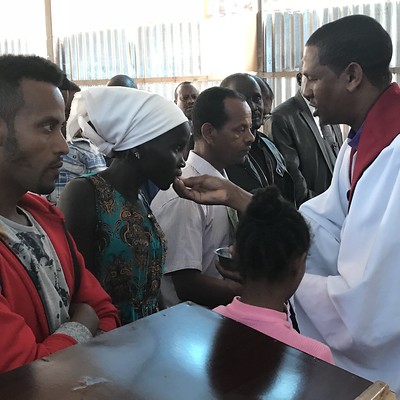
We started about two and a half hours late. People continued to trickle in during the entire service which, as I mentioned earlier, lasted four hours. I had a front row seat to a dozen different choirs, each performing 2-4 songs apiece. I witnessed 22 children and 4 adults become heirs of God’s kingdom through the sacrament of Baptism. I heard the Confirmation vows of 35 youths and adults to remain faithful to Christ unto death. I watched 167 people receive Jesus’ real body and blood in Holy Communion for the forgiveness of their sins. I heard the pastor preach two sermons – one was centered on Jesus’ Sermon on the Mount, the other was about using gifts of time, talent and money
for God’s glory. At one point during the service the ushers came around with 2 bowls of raw corn, and to their dismay I tried snacking on a few kernels. My wife correctly observed that everyone else took a kernel from one bowl and put it in the other, as a way of counting those in attendance. The final number announced was 467, give or take a handful of corn.

After the worship service we introduced ourselves to the group in Chichewa and listened to various church elders introduce themselves. It took some time to shake everyone’s hand on the way out of church but we felt honored. The Pastor spent another hour teaching advanced Bible classes to three men who are preparing themselves for entrance exams at the Lutheran Bible Institute. Our hosts graciously prepared a lunch of nsima and chicken for us, then we started back with about an hour and a half of daylight left. We got directions for a better way to travel by car which, although longer in distance was much more suitable than the way we had come and eventually led us back to the tarmack.

Music is an important part of youth ministry in the LCCA

It’s true here and in the United States that country life is much different the city. 80% of Malawi’s population lives in rural areas, some more remote than others but most with limited access to medical care, good roads and electricity. Most of the pastors of the LCCA Malawi live in the same rural communities as their members, in order to serve them better. This spring, five Malawian men will graduate from the Lutheran Seminary in Lusaka, Zambia. Perhaps one of them will be assigned to serve the five churches of Chilembwe, Chingwakwa, Msokoneza, Kamwaza and Yotamu but it will not be easy for the congregations to support him. But what I observed during that Sunday in
Chilembwe shows me that God’s Spirit is actively working in the hearts of these people, who biked or walked many miles to receive the comfort of the Gospel. A lot happened during that four hour church service, but a lot more is happening out of our sight.

Missionary John Roebke lives in Malawi.

Please pray for those working in fields that are ripe for harvest. Share their story, engage with future news and receive updates. Learn more about our mission fields in Africa and how the Holy Spirit is working faith in people’s hearts at https://wels.net/serving-others/missions/africa


Howzit goin’?

“Howzit goin’?” I used to hear
in the States.

Now: “Muli bwanji?”
(“How are you”?)

My wife Debbie, my son Drew, and I moved from Minnesota to
Lusaka, the capital of Zambia, in early December 2019.

My future role: Theological Educator for the One Africa Team
of the Wisconsin Evangelical Lutheran Synod, concentrating especially on formal
continuing education for African pastors in our fellowship.

My current role: Newbie. Learner. OAT called me to spend at
least the first 6 months here learning as much language and culture as
possible.

How is that going? There is too much to tell.


Pithy proverbs may help. That is, let’s zero in on 28
January 2020, one of the best days I have spent in Africa.

Malawian pastors Stanley Daile and Alfred Kumchulesi at the
Lutheran Bible Institute in Lilongwe, Malawi took many hours out of their day
to get to know me and help me get to know them, their lives, their city, their
heart language, and the future pastors they teach.

After a particularly comforting morning devotion by Pastor
Kumchulesi on God’s forgiveness as seen in Psalm 32, I went with Professor
Darlington Mwakatika to an LBI class which focused on English and Chewa
proverbs.

The easiest Chewa proverb for me to learn was the shortest: Safunsa anadya phula.
“The-one-who-didn’t-ask ate wax.” He could have had honey, the dummy, if he had
only asked for help.

That proverb sums up much of my last months. I keep asking abale anga, my brothers and sisters,
both Western and African, about their lives, their language, their customs,
their faith, their suggestions for what to do next, and more.

Otherwise, Nzeru za
yekha, anaviika nsima madzi.
“Wisdom-of-himself — he soaked nsima in water.”

Only a fool would take a handful of his maize flour
porridge, nsima—an important staple
in central African diets—and dunk it in water. That would ruin it. But Mr.
Know-it-all did that.

New missionaries, thinking they are wise, can become such fools.
(“I am familiar with biblical Hebrew. I have been a pastor since 1992. I know
how things work in the States.”) But pride poisons everything. Pride offends
our holy God. It also ruins relationships with abale athu, our brothers and sisters.

Bought by blood, though, forgiven through faith in the true Nzeru za yekha, Jesus, who really is all
wisdom-in-himself—oh!

My family and I are so glad for the gospel preaching of our
pastor Chibikubantu Simweeleba; the seminary senior assigned to our
congregation, Justin Namakhwa; and the elders who also do some of the preaching
at Bethel, the congregation we attend.

We wish you could hear the youth and ladies choirs here,
too. Click this link to watch https://youtu.be/Fqjj1A6O8DE
For most Sundays, both choirs have learned four a capella songs. The youth choir sings a recessional as well. I’m
catching more Chewa words all the time, but from the first service we attended
in December—words fail. Such conviction. Such joy in the Lord in the choir
members, young and old.

One of our favorite new customs comes at the end of each
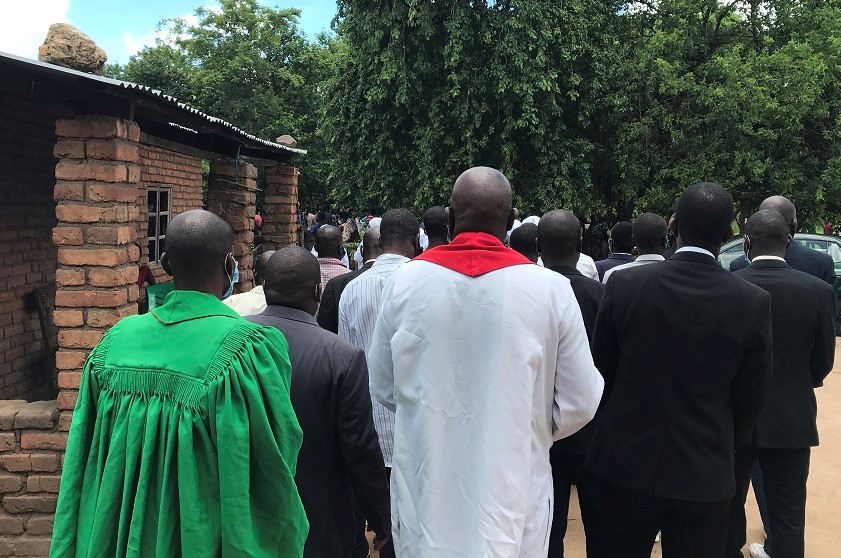
service. Out the door of the church building walks the pastor, then any special
guests, then all of us, one by one. Unlike your church, probably, here everyone
takes their place in a line outside stretching into a large circle. Everyone
shakes everyone else’s hand, taking a new place in the circle, while the youth
choir continues to sing and shake hands at the same time, at the end.

Such highlights are more important to share than

  • what it has been like to wait for our shipment to arrive, or
  • which American conveniences we miss, or
  • what it has been like for Debbie and me to learn to shift with our left hands and drive a manual transmission Ford Ranger 4×4 on the left side of the road, or
  • what the international school has been like so far for Drew.

How is it going? In short, we are part of great team. We
learn and adjust daily. We are especially learning to lean more on God.

One last Chewa proverb: Kuona maso ankhono kudeka. “To see the eyes of the snail [requires] to slow down.”

That big snail inched up a mango tree in our yard the other
day. Can you see its eyes, up at the top of the Y? Did you have to slow down
and look closely to see them, against the tree?

That is how it is going. Pang’ono,
pang’ono
, “my friend,” munzanga, Mr.
Zulu, tells me all the time. I tell it to others, when they ask especially
about language learning: “bit by bit.”

“Slow but sure,” munzanga
Mr. Kalima put the proverb to me.

You too: Thanks for all your little-by-little, slow-but-sure
prayers and support for us and all WELS missionaries and their families. Keep
it up, slow-but-sure, for Jesus’ sake.

Missionary Dan Witte lives in Zambia

Please pray for those working in fields that are ripe for
harvest. Share their story, engage with future news and receive updates. Learn
more about our mission fields in Africa and how the Holy Spirit is working
faith in people’s hearts at 
https://wels.net/serving-others/missions/africa