Enter Stage Right

A corporate merger is a process that happens one stage at a time. It unites two or more business organizations with overlapping interests. The decision may be made mutually by all parties. The goal is to increase the efficiency and reach of the new entity’s brand. The decision to merge may be the unintended consequence of financial difficulties that one of the partners is experiencing. A hostile takeover often leads to the dissolution of the weaker partner’s identity and assets.     

Mergers between church bodies occur frequently for similar reasons, and with similar results. Instead of struggling to maintain separate worker training systems, church bodies can send their future called workers to the same schools. Church bodies can combine their resources to more effectively deliver humanitarian aid to the people in their communities. But the administrative advantages that are gained come with a cost. Church mergers often come at the expense of doctrinal integrity. Church bodies “agree to disagree” in the name of compromise.


The CICR

The Wisconsin Synod stands firm in its commitment to advancing God’s Kingdom. WELS works with like-minded partners without compromising pure teaching or evangelical practice. The WELS Commission on Inter-church Relations (CICR) is an agency for preserving and strengthening relationships with other church bodies. These relationships are built on the foundation of complete unity of doctrine and practice. You can read a summary of the CICR’s work and mission at https://wels.net/commission-inter-church-relations-holds-fall-meeting/

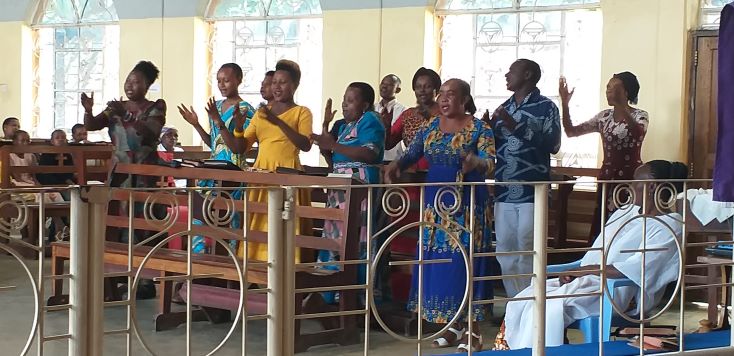
The choir of the AMEC congregation in the village of Akeri

WELS has an increasing number of mission opportunities in Africa. The CICR and OAT have developed a Four-Stage process to guide discussions with potential ministry partners. The process outlines benchmarks that must be met to continue the dialogue. The end result is a formal declaration of fellowship. We and our potential partners discuss our understanding of Lutheran teachings. We explore evangelical ministry practices. We also outline our expectations of what this partnership may entail. The process continues on the condition that both parties agree.

AMEC

The Lutheran Church has deep historic roots in the East Africa country of Tanzania. German missionaries were active in the region during the last two decades of the 19th century. The Evangelical Lutheran Church of Tanzania (ELCT) numbers almost 8 million members. There are also smaller Tanzanian Lutheran church bodies.

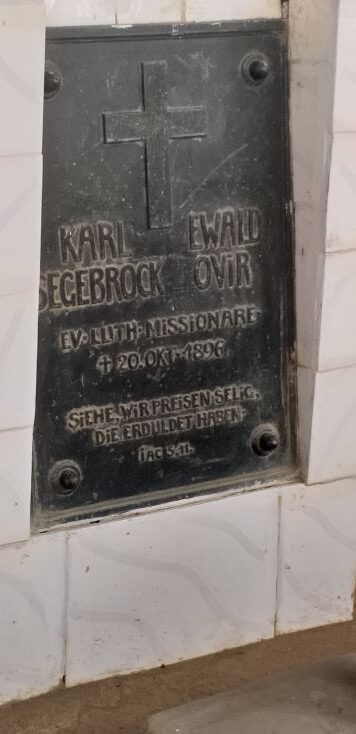
The graves of martyred German Lutheran missionaries to Tanzania

The African Mission Evangelical Church (AMEC) is a Lutheran Church body in Tanzania. It was formed in 1993 as the result of a split within the ELCT over doctrine and practice. In 2019 WELS received an inquiry from Pastor Davis Makundi of the AMEC. One Africa Team Missionary John Hartmann has been corresponding with Rev. Makundi.

AMEC’s future is in danger both doctrinally and organizationally. After the split with the ELCT, AMEC has struggled to maintain a corps of confessionally Lutheran pastors. AMEC never set up its own worker training system. Many congregations are served by pastors who were trained in non-Lutheran seminaries. This has led to a weakening of doctrinal unity in the church body.

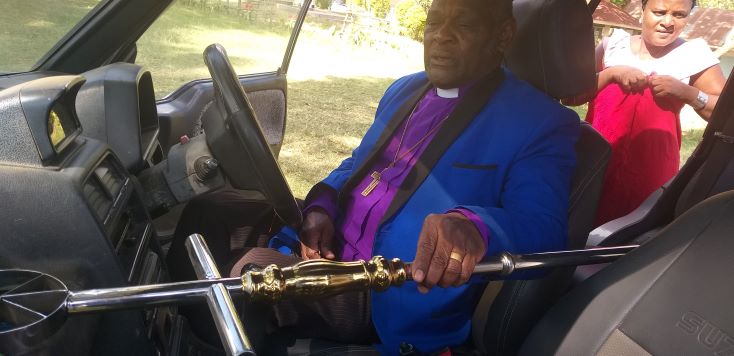
Bishop Baltazari Kaaya is AMEC’s leader

AMEC’s leader, Bishop Baltazari Kaaya, was trained in the ELCT Seminary many decades ago. He is committed to the teachings of the Confessional Lutheran Church. He recognizes his church body’s need for new pastors who are committed to Lutheran teaching and practice.

Stage One

One Africa Team is using the Four-Stage Process with AMEC. In April 2021 Missionary Hartmann made a preliminary visit to meet with about a dozen AMEC pastors. This was an opportunity to learn more about their history and to introduce them to the WELS. In November 20201 Missionary Hartmann and Missionary John Roebke made a follow-up visit to begin Stage One of the process.

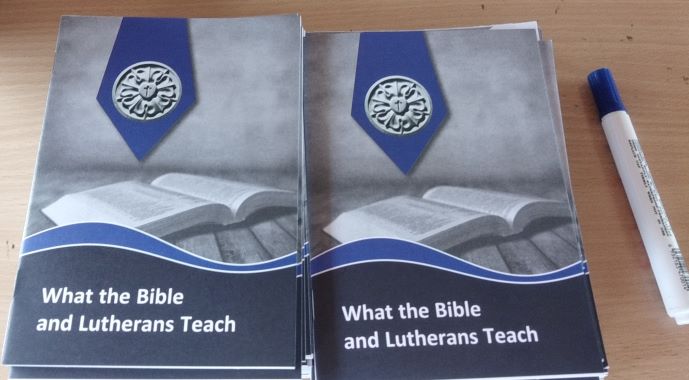
What the Bible and Lutherans Teach has been published in 26 languages

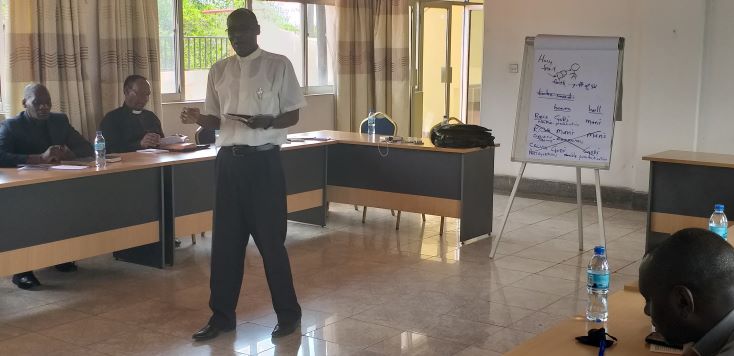
The purpose of Stage One is to determine if we have the same understanding of Lutheran doctrine. Hartmann and Roebke met with a dozen AMEC church workers for one week. They read and discussed the pamphlet What the Bible and Lutherans Teach

Pastor Mark Anariko Onunda of the LCMC-Kenya accompanied the two Missionaries. He served as both a linguistic and a cultural translator. Rev. Onunda is the leader of the LCMC-Kenya, one of WELS’s mission partners in Africa. Some of the topics that were discussed included the Triune God, Man and Woman, Justification, Conversion, and Baptism. It took about 1-2 hours to discuss each teaching and related questions. The mission team intends to return to Tanzania in 2022. They will discuss other key teachings such as the Lord’s Supper, Fellowship, Marriage and Divorce, and the Government.

Rev. Mark Onunda is the leader of the LCMC-Kenya

The Next Stages

God-willing, the WELS and AMEC will continue to make process in their discussions. Stage Two provides an opportunity to compare our understanding of church practices. We take a look at Worship, Bible Study, Stewardship, and Ministry training. In Stage Three, we review the church body’s existing church structure and constitution. We ask for clarifications or make suggestions for improvement.

The Fourth Stage is working with the partner to prepare a formal request for fellowship to the CICR. We help organize face-to-face talks with representatives from WELS. WELS then recommends the church body to its partners in the Confessional Evangelical Lutheran Conference (CELC).

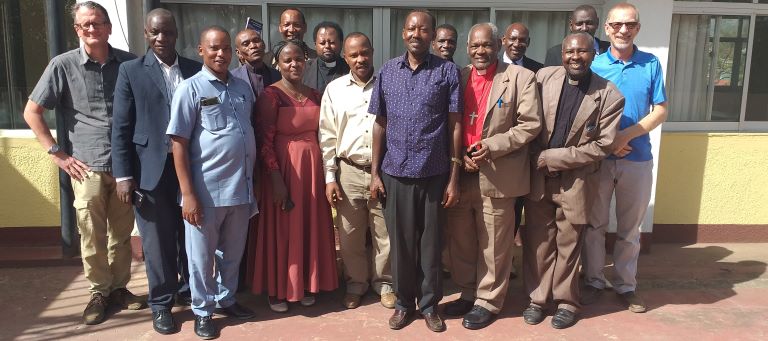
OAT Missionaries and church leaders of AMEC met in Arusha, Tanzania in Novemer 2021

The WELS does not merge with its sister churches around the world. Rather, the WELS recognizes each of them as an independent church body. This is in everyone’s best interests. An autonomous church body is much stronger and healthier than one which is dependent on another church body for support. The WELS wishes to use its God-given resources to help sister church bodies around the world. WELS helps them develop and grow in ways that are appropriate for each partner. May God bless our efforts with AMEC in Tanzania and elsewhere around the globe.

Missionary John Roebke lives in Malawi

Please pray for those working in fields that are ripe for harvest. Share their story, engage with future news and receive updates. Learn more about our mission fields in Africa and how the Holy Spirit is working faith in people’s hearts at https://wels.net/serving-others/missions/africa


A Bigger Plan

Things did not go according to the plan. No, not even by a mile.

What was the plan? The Lutheran Church of Ethiopia (LCE) wanted to start a Lutheran nursery school. The plan was that there would be three age levels – something like nursery school, preschool, and kindergarten. In addition to the normal subjects, students would be taught the word of God. The LCE planned to offer these classes in the city of Bishoftu, in the building where their largest congregation gathers to worship every Sunday. They planned to enroll about 75 students, some from their own membership and others from their community. The LCE leaders contacted all the appropriate government offices. They were very careful to follow all the government rules and regulations. And if everything went well with the nursery school, then they would add Grade 1 the following year. That was the plan.

But things did not go according to the plan. In fact, none of it happened. Everything failed. There is no nursery school in Bishoftu. Not a single child is enrolled there.


A Snag in Plans

What happened? As the time drew near for the school to open, it became clear that things were not going to go smoothly. All along, the government officials had been saying, “Oh yes, everything is fine,” yet they were delaying and delaying and delaying. They were refusing to give their final approval for the school. No one would say what the reason for their refusal was, but the bottom line for the LCE was that the local government officials would not grant permission for the school. All their carefully laid plans had failed.

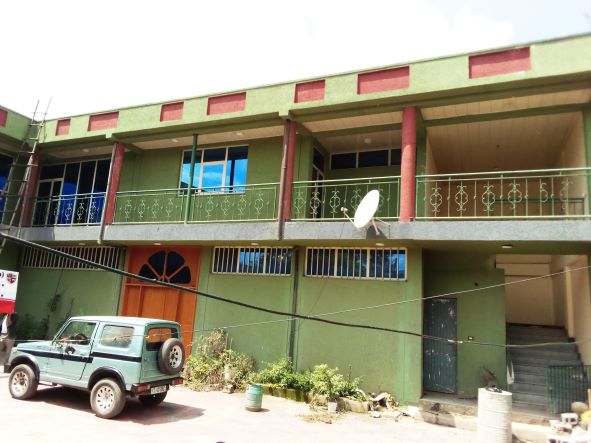
one of the two buildings in Dukem used by the LCE for their Christian school

But God had other plans. Shortly after the bottom fell out in Bishoftu, the LCE was contacted by the Bureau of Education from a nearby town. The nearby town is called Dukem; it’s just a few miles from Bishoftu. The government officials from Dukem urgently pleaded with the members of the LCE, “If they will not let you have a school in Bishoftu… please, please, please come and have your school in Dukem!”  They helped the LCE find two buildings where classes could be held. The officials in Dukem promised that they would provide government land on which to build a new facility in the future. They strongly urged the LCE not to limit the enrollment to just three levels of nursery school, but also to include some higher grades as well. They quickly processed all the paperwork and gave the necessary approvals.

A Greater Opportunity

And what was the end result? A brand new school in Dukem with two separate campuses.  About 30 new teachers. Students in the 3 nursery levels, plus Grade 1, Grade 2, Grade 3 and Grade 4.  Current enrollment: 759. That’s right, seven hundred and fifty-nine. That’s ten times more than the LCE had originally planned.

Do you ever end your prayers the way Jesus did in the Garden of Gethsemane: “Not my will, but yours be done”? How do you feel when you say those words? Honestly, when I say those words, I’m often thinking to myself, “My will is the best. God’s will is second-best, and I’ll be disappointed if that’s what I receive. So God, please help me to grin and bear it when I don’t get what I want.”

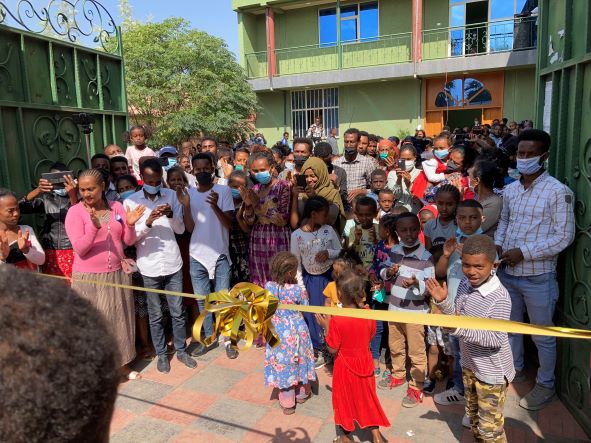
members of the Dukem community celebrated the dedication of the LCE’s new school

Our Christian brothers and sisters in the LCE did not get what they had planned or wanted. They got ten times more than that.

So go ahead and make your plans. Make those plans as bold and ambitious as you see fit. But in the end, submit yourself to the will of God – not because you have to, but because God’s plans are better than yours.

Now to him who is able to do immeasurably more than all we ask or imagine, according to his power that is at work within us, to him be glory in the church and in Christ Jesus throughout all generations, forever and ever! Amen. (Ephesians 3:20,21).

Mark Panning lives in Malawi

Please pray for those working in fields that are ripe for harvest. Share their story, engage with future news and receive updates. Learn more about our mission fields in Africa and how the Holy Spirit is working faith in people’s hearts at https://wels.net/serving-others/missions/africa


Translation Foundation

Half a lifetime ago I locked myself into a room with a Bulgarian pastor. We were reviewing translations of Bible commentaries and the Lutheran Confessions. We used to argue for hours over how to best convey complicated theological concepts and terms in the Slavic tongue. I learned the hard way that translation work takes great skill, patience, and flexibility. The Star Trek universal translator machine is ridiculous fiction. Google algorithms can translate individual words and phrases, but it always fails to see the forest for the trees. Computers lack the ability to analyze, decode and transmit human speech from one language to another. There is no substitute for the human mind.


Plans Change

WELS Multi-Language Productions (MLP) facilitates the production of Biblical Lutheran literature for use in its world mission fields. MLP encourages both the translation of existing English books as well as the production of original materials in other languages. The One Africa Team asked MLP to sponsor a translation workshop for WELS mission partners in Africa in 2021. MLP sponsored publications conferences in Lusaka, Zambia in 2018 and 2019. WELS partners from Ethiopia, Kenya, Nigeria, Cameroon, Zambia, Malawi, India, and Nepal attended.

screenshot from online translation workshop
screenshot from the online translation workshop

COVID19 disrupted the One Africa Team’s plans to host an in-person publications event in Lusaka during 2021. We had concerns about the safety of our guests and the student families living on the Lusaka Seminary campus. That led us to adjust our plans and offer an online event. Over five days, Dr. Ernst R. Wendland used the online teleconferencing program Zoom to present his material. Dr. Wendland has served WELS missions for over half a century. He teaches Biblical languages at the Lusaka Seminary and has coordinated translation work for the United Bible Society of Zambia.

the United Bible Society’s translation of the Bible into Amharic

Workshop Takeaways

Translators have to change the form of the original text to convey its meaning accurately. That may mean changing the word order or even the order of the sentences. This may mean eliminating words that are redundant or have no local equivalent. They may need to add words or phrases that convey a concept similar but are not identical to the original. It may be necessary to replace a technical term with a generic word, like translating “Paraclete” with “Helper.” There are many other kinds of changes that a translator must make to the form of the original text. Otherwise, the original meaning will be lost or presented incorrectly. It took many months and many heated discussions with my Bulgarian counterpart for me to understand and appreciate this concept. I was very uncomfortable with changing the form of the original text, but a word-for-word translation doesn’t help readers either.

The MLP tract, “What the Bible and Lutherans Teach” has been translated into 25 different languages

A second takeaway from the workshop is that translation work is both an art and a science. The legend that 70 Jews individually produced identical translations of the Old Testament into Greek is laughable. There is more than one way to translate any text, but some ways are superior to others. Every translation can be improved by a review. The best translations are not produced by superstar solo artists, but by collaborative bands working in harmony. An ideal translation team consists of the translator, language consultants, a reviewer(s), and a copy editor. It takes a lot of time and money to publish a book. As a publication has a long-lasting influence on future readers, it’s worth the effort to produce a high-quality translation.

A Worthy Legacy

Dr. Wendland is a world-renowned linguist and translation expert. However, the principles he shared at our workshop can be used by anyone interested in and committed to translation work. He modeled the importance of asking questions about the meaning of the original text.

In my experience, translating a text from one language to another gives you a better understanding of its meaning. When you translate a text, you must ask yourself what the author originally meant. It’s painstaking work, and it’s not everyone’s cup of tea. But producing a high-quality translation of a theological book is a church body’s priceless legacy. We thank God for men like Dr. Wendland who have slashed through the jungle and shown us the path forward.

Missionary John Roebke lives in Malawi

Please pray for those working in fields that are ripe for harvest. Share their story, engage with future news and receive updates. Learn more about our mission fields in Africa and how the Holy Spirit is working faith in people’s hearts at https://wels.net/serving-others/missions/africa